
Galveston City Directory Collections by Year
Rosenberg Library’s Galveston & Texas History Center, usually called GTHC, is the central local shelf for Galveston city directories. Its collection summary describes physical and reference holdings from 1856 through 2024. Access changes with the run. Portal to Texas History carries digitized volumes from 1859 through 1925, while the library describes 1856-1860 and 1866-1938 on microfilm, 1866-1960 through HeritageQuest with a library card, and later bound editions in the reading room. The coverage is strong, but a missing hit in one edition is still only a missing hit in that edition.
| Collection | Years | Where held | Access route |
|---|---|---|---|
| Galveston city directories | 1856-2024 physical holdings | GTHC | microfilm or bound reading-room editions |
| Digitized Galveston directories | 1859-1925 | Portal to Texas History | online page images |
| Library database run | 1866-1960 | HeritageQuest and Ancestry Library Edition | library card or in-library access, as applicable |
| Address cross-reference sections | begins 1908 | GTHC directory run | address-to-occupant research |
| Telephone directories | 1904-current | GTHC Book Room | subscriber-name bridge between editions |
The collection includes identified editions by C.W. Marston, W.A. Fayman and T.W. Reilly, Morrison & Fourmy, and later directory titles from 1921 and 1923. Publishers and formats changed, so preserve the title page and year with every transcription. The 1899-1900 volume calls itself a twelfth edition and advertises its own completeness, but that is a publisher claim, not a guarantee about any individual listing.
GTHC’s Galveston city-directory collection is the best source to check before choosing a year.
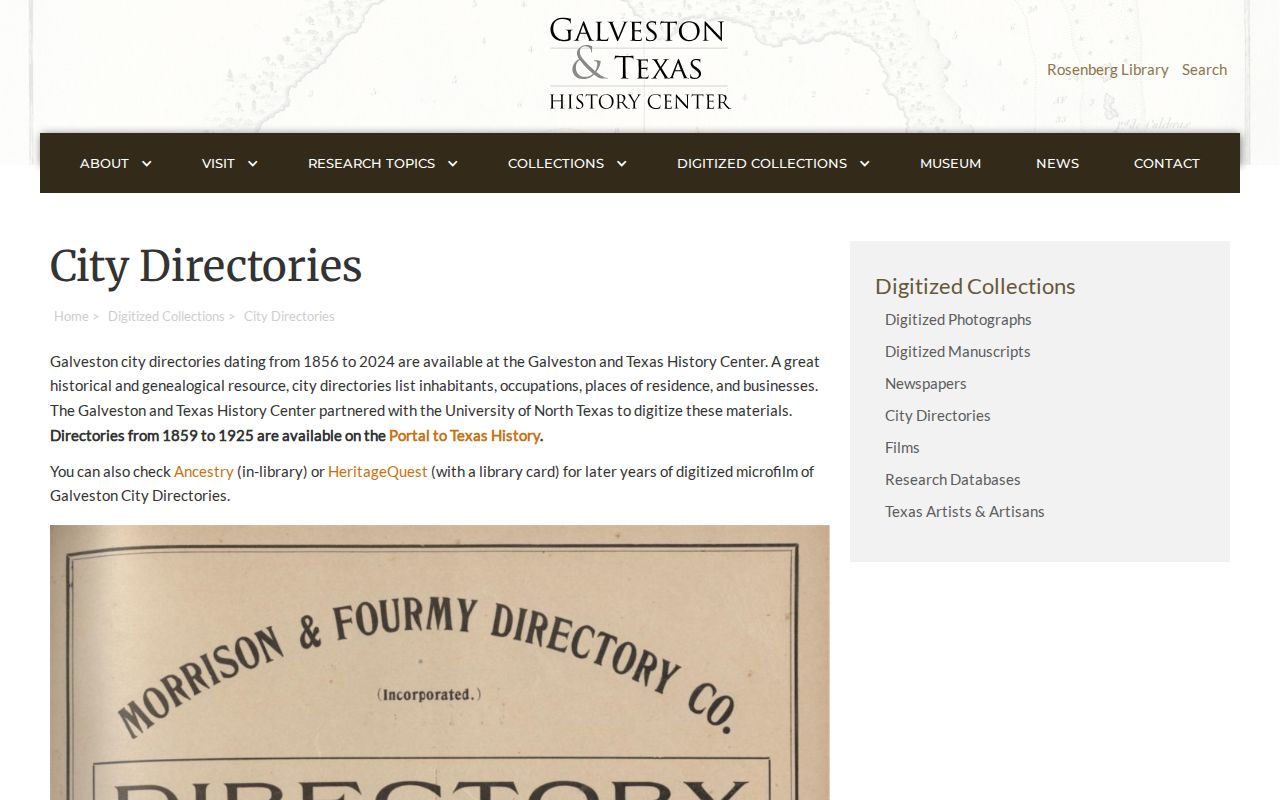
The collection screen is a useful reminder that one Galveston city directory search may lead to a scan, a microfilm reel, a library database, or a bound volume rather than one universal index.
Galveston City Directory Access Routes
Use the online scan when it exists, but keep the library route ready. The GTHC genealogy resources identify remote library-card access for HeritageQuest and NewspaperArchive. Ancestry Library Edition and some FamilySearch material are available in the library rather than at home. The History Center is at 2310 Sealy Avenue and lists Tuesday through Saturday hours of 10 to 5, with archivist assistance at 409-763-8854 ext. 126 or gthc@rosenberg-library.org. Ask staff for a specific year, surname variant, street name, or box and folder, instead of asking for a broad search of every local collection.
Rosenberg Library’s e-Library identifies the database routes used alongside the printed and filmed directory runs.
The e-Library route matters when a directory year is not openly digitized, because access may depend on a library card or an in-library research session.
The Galveston History Center archive also points researchers toward manuscripts, photographs, maps, and related archival holdings.
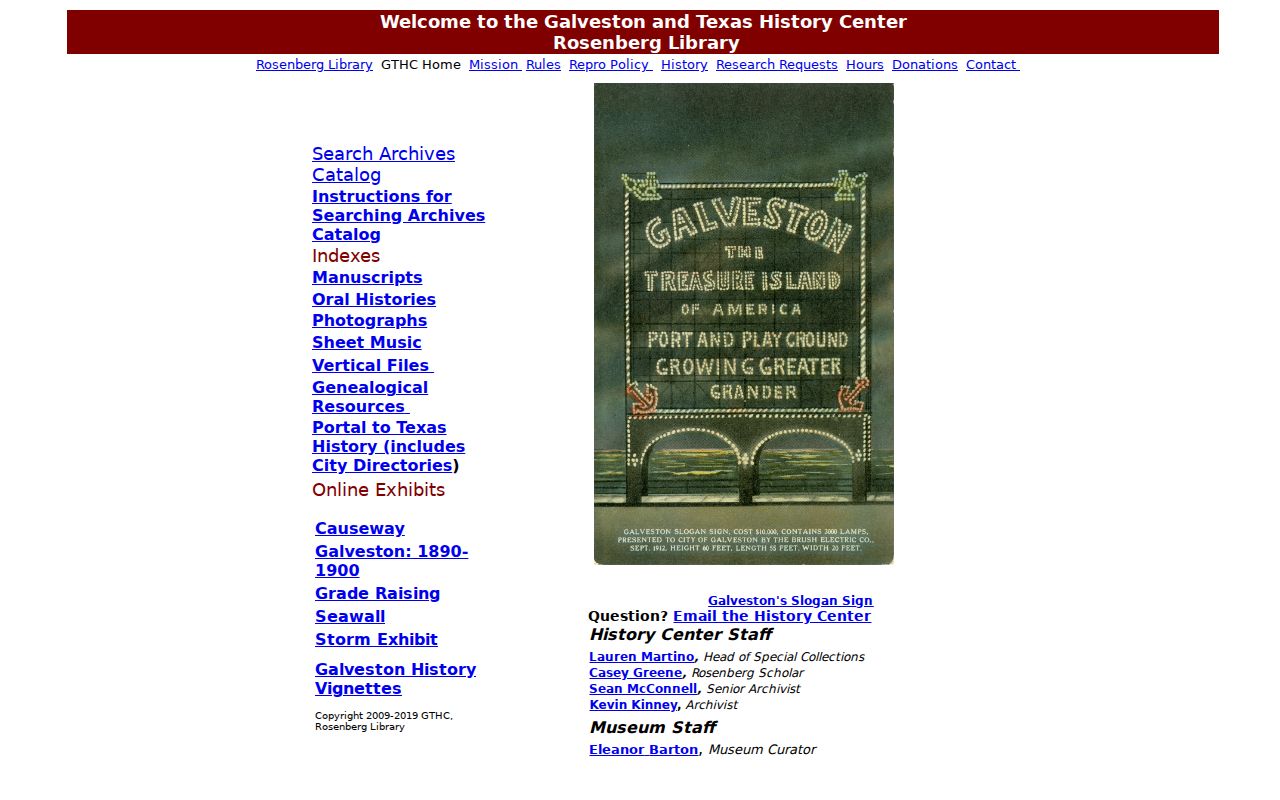
Archive material can add context to a directory address, but it should be cited as its own source rather than folded into the wording of a city-directory entry.
Note: When no online page appears, give the GTHC the year, name variant, address, and requested format so staff can direct the search efficiently.
Galveston City Directory Pages Online
Page images are more reliable than OCR alone. The 1870 source has a heading for the Galveston residence directory and commonly combines a surname, initials or title, occupation or business, and a residence phrase. It may add a street number, avenue, intersection, or a “bet.” description. The page image is needed because the OCR can misread names and street words, especially in older type. In the period geography, Post Office is an alternate form for Avenue E.
This 1870 Galveston residence-directory page shows the type of original image that should be checked after an OCR search.
Transcribe the words as printed, including the residence abbreviation and street form, then save the page reference with the research note.
The 1868-69 Galveston city-directory page provides another period scan for comparing spellings and address style.
Comparing nearby editions can distinguish an OCR error from a real change in spelling, business description, or residence wording.
The 1921 Galveston city-directory page is a later example with its own set of abbreviations and household clues.
The 1921 volume can show a surname heading, a spouse or household name in parentheses, an occupation or employer, a residence mark, rooms notation, and an address. Historical racial notation printed in that volume must be transcribed only when needed for faithful historical citation, never generalized beyond the entry.
Galveston Directory Collection Timeline
The local timeline describes access and surviving holdings, not a claim that every year was printed or has the same search features. Keep the format tied to the specific year in question. The address-oriented material appears later than the earliest surname directories, and a researcher may need to move between a scan, microfilm, database, telephone book, or bound volume as the trail advances.
| 1856 | GTHC reports its physical city-directory holdings begin with this year. |
|---|---|
| 1859-1925 | Portal to Texas History provides the digitized Galveston directory span identified by GTHC. |
| 1904-current | Telephone directories in the GTHC Book Room can bridge some directory gaps. |
| 1908 | Address cross-reference listings begin in the GTHC city-directory runs. |
| 1938-current | GTHC describes later city-directory editions as bound reading-room volumes. |
| 2024 | The current GTHC holdings summary reaches this endpoint. |
This timeline makes one practical point: a surname search that works for an 1870 scan will not necessarily be the best method for a later Galveston address search. Start with the year’s format, then use its available access channel.
Reading a Galveston City Directory Entry
Read an entry field by field. In the inspected volumes, “r.” signals residence, while “h.” or home can identify a house or residence in context. “bds.” means boards or lodges, “rms.” means rooms, “bet.” means between, “cor.” means corner, and “ave.” means avenue. A spouse name in parentheses, a widow notation, or a lodging mark can be a useful household clue. It does not establish a legal relationship, ownership, or a complete list of people at the address.
| Name form | Surname, initials, title, and spelling exactly as the volume prints them. |
|---|---|
| Occupation or business | A dated activity clue that may include an employer or business name. |
| Residence wording | Street number, avenue, intersection, “r.”, “bds.”, or “rms.” notation. |
| Household clue | Parenthetical spouse, widow notation, or lodging wording where printed. |
| Page image | The evidence needed to check OCR, abbreviations, and the column context. |
- Criss-cross directory
- A reverse section arranged by street or address. GTHC says Galveston address cross-references begin in 1908, making it a route from a house toward an occupant clue.
- Householder index
- An index organized around the listed household or residence name. It is a directory tool, not a complete census.
- Abbreviation key
- The volume’s printed explanation of marks and short forms. Photograph or transcribe it before expanding abbreviations in notes.
Galveston City Directory Street Names
A Galveston city directory may use a street form that a modern map does not display. Avenue J is Broadway, Avenue E is Postoffice, Avenue F is Church, Avenue G is Winnie, 21st Street is Moody, 22nd is Kempner, 23rd is Tremont, 25th is Rosenberg Avenue, and 29th is Martin Luther King. The source-year form belongs in the transcription. Search the modern alias as a second route, then compare block, lot or outlot, cross street, and page image before treating the two forms as one address.
This is an important Galveston city-directory check because a house number can change and an avenue can acquire a later commemorative name. The City GIS layers and a historic map can corroborate geography, but they do not certify a deed or prove that a person lived at every address attached to a name. Keep the directory entry, map clue, and property record as separate pieces of evidence.
Galveston City Directories After the 1900 Storm
The 1900 Storm is a real break in many Galveston research trails. GTHC reports archive damage and loss from the disaster, while the local records landscape can move abruptly from a directory or newspaper to a death list, mortuary book, cemetery record, or survivor notice. GTHC’s recorded-deaths project checked more than 5,000 names against 1899-1900 directory and newspaper material, yet it warns of misspellings, duplicates, uncertain identification, and incomplete illness-related coverage.
For a household that disappears around the storm, compare the 1899-1900 directory with newspapers, the recorded-deaths material, cemetery volumes, mortuary records, and probate where appropriate. A missing name in the next directory is a question to test, not proof of death or departure. This local interruption is why a city directory works best as one dated item in a documented evidence chain.
Note: Cite the exact directory year and page before connecting a storm-era disappearance to any death, burial, or probate record.
Trace a Galveston Directory Household
For family history, build a short sequence rather than a single entry. Start with the first usable surname appearance and retain its page image. Follow the name through the nearest available annual or biannual editions, recording spelling, address, occupation, spouse or household notation, and lodging status. When a later volume has an address cross-reference, work from the address back to the name. The shift after 1908 makes the later Galveston city directories especially useful for house-centered research.
- Find the surname in the nearest available directory year and record the entry exactly as printed.
- Search the next available editions for the same surname, initials, spouse notation, and street alias.
- Use the address cross-reference in 1908 or later material to compare an address with its listed occupant clue.
- Pair the directory sequence with released federal census schedules. The research file identifies 1940 and earlier as public, with 1950 public since 2022; 1960 is not ordinarily open as of the research date.
- Use newspapers, cemetery material, or an obituary route to test a move, death, or business change without assuming the directory alone explains it.
A directory entry is an annual commercial compilation, while a census captures a household on its census date. Those are different snapshots. If an older listing raises a need for a separate modern record check, the Galveston resident lookup route keeps that question distinct from the historical directory shelf.
Galveston City Directory Companion Records
When a directory trail ends, use a companion source that answers a narrower question. GTHC holds Galveston Daily News runs for 1863-1869 and 1870 forward, Galveston News for 1846-1863, and scattered Galveston Tribune issues from 1885-1965. The center also maintains vertical files on people, obituaries, addresses, schools, religious institutions, civic groups, UTMB, and local businesses. These are finding aids and deposited collections, so ask for the exact topic and date range before relying on a folder.
Church records, passenger lists, cemetery compilations, and naturalization material can supply another dated clue. The Texas State Library and Archives Commission inventory identifies deed records, district-court indexes, naturalization declarations, and WPA index reels. None of these records makes a directory entry absolute. Together, they can make a well-cited Galveston family-history trail stronger.